Learning About Property Investment

In this blogpost, I introduce Gamestonk Terminal, an open-source project that aims to be a comprehensive tool for financial analysis and stock market research. It includes functionalities for discovering stocks, market sentiment analysis, fundamental and technical analysis, due diligence, prediction techniques, and more.
The open source code is available here.
I come from a country where 94.3% of people own their homes. Homeownership there is the norm. I now live in Germany, where the ownership rate is much lower, around 46–47%, and if you zoom in on Berlin, it drops dramatically to 15–20%. Renting here isn’t a transition phase; it’s a long-term reality for many people.
Seeing this difference made me want to better understand property investment in Germany, especially how it works in practice and how different the model that was previously familiar to me.
Yesterday, I had a good opportunity to explore this by attending a property investment workshop by Financemate in Berlin. The workshop focused on understanding the local rules and working through concrete examples.
Learning the Local Rules Matters
One of the main points emphasized was how important it is to understand local regulations before making any assumptions about property investment.
For example:
-
In Germany, the government offers subsidies for historical buildings
-
Interest paid on a loan used to purchase an apartment can be tax-deductible when the property is used for business purposes
These are not universal rules and can vary significantly from country to country.
Renting Out Property Is Treated as a Business
Another key point is that buying an apartment to rent it out is considered a business activity in Germany.
Because of this, several deductions apply, including:
- Interest on the loan
- Property management costs
- Running costs
- Depreciation
This is different from buying an apartment for personal use, where these deductions generally do not apply.
Depreciation Rules in Germany
Depreciation was a large part of the discussion.
Most residential buildings are considered to depreciate at 2% per year, which corresponds to 50 years.
To stimulate housing construction, buildings constructed between 1 October 2023 and 30 September 2029 can be depreciated at 5% per year.
A few important details:
- Depreciation starts per owner, meaning that if ownership changes, the depreciation period starts again
- For expats, it’s important to know that if you leave Germany, you may have to pay back the depreciation
Working Through the Numbers
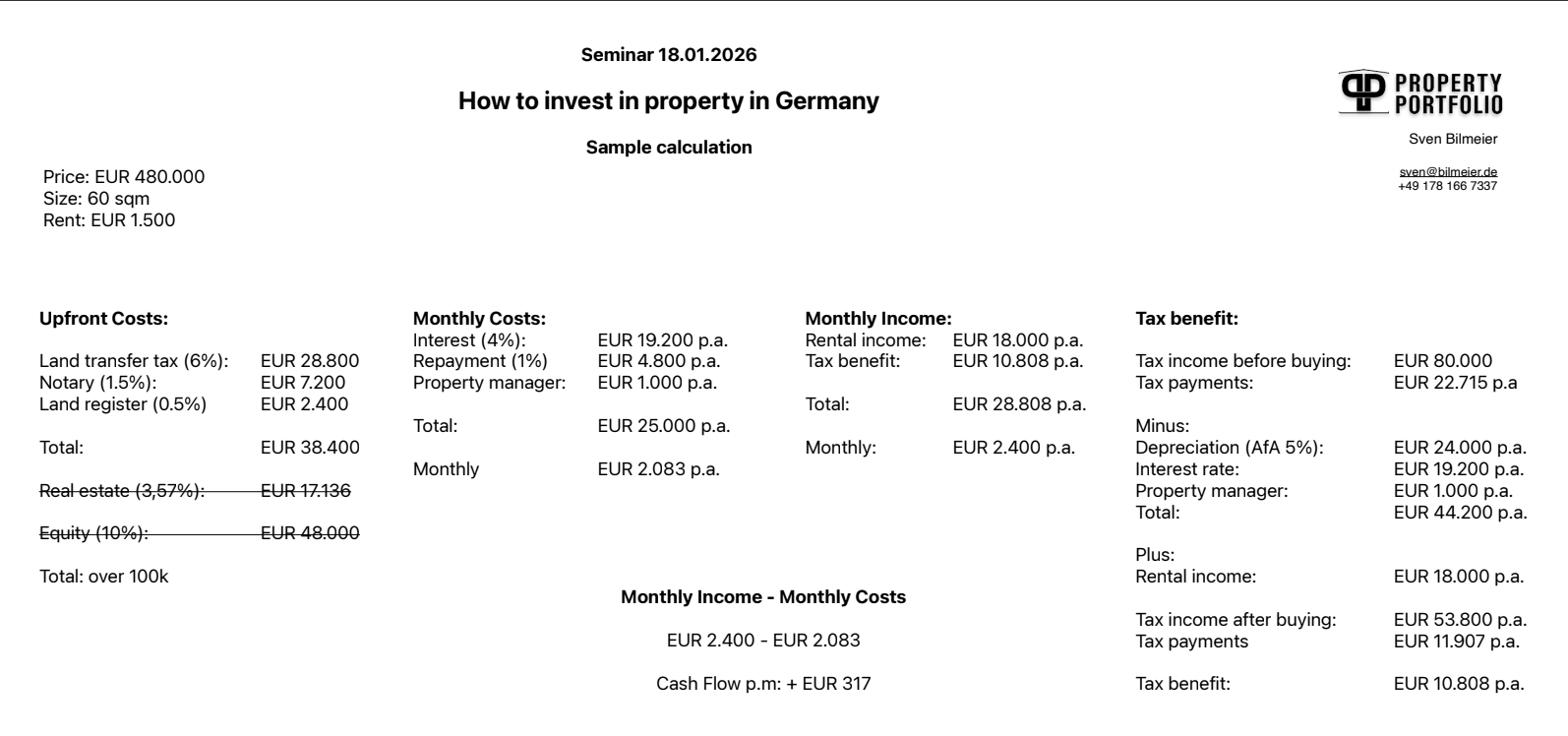
During the workshop, we went through an example of purchasing a property and calculated the numbers step by step to understand how everything works in practice.
We first did this on paper, and then used the Financemate app (https://financemate.de/ ) to model the same scenario digitally and validate the calculations, as well as explore other options. The app offers a great flexibility in modelling different scenarios.
Final Thoughts
The workshop helped me better understand how property investment works in Germany, particularly how tax rules and depreciation affect the overall picture.
For me, the main takeaway was that assumptions based on other countries don’t necessarily apply, and understanding the local rules is essential before making any investment decisions.